|
||||||||||
| PREV CLASS NEXT CLASS | FRAMES NO FRAMES | |||||||||
| SUMMARY: NESTED | FIELD | CONSTR | METHOD | DETAIL: FIELD | CONSTR | METHOD | |||||||||
public interface ValuesHolder
Definition of objects which are capable of holding values (settings) for other objects.
This interface attempts to define the minimal functionality in
for implementations which are designed to work with the values of a
particular class of objects. In particular, a ValuesHolder
can:
Here is a simple UML Class diagram:
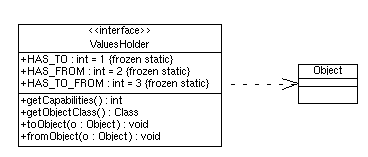
For example, consider the TimeSpan
object. One might want to design a Swing component which can load
the values from the TimeSpan object, let the
user edit the values, and then store them back into the TimeSpan object. Another example, could involve a
properties file, where the values for the TimeSpan object are stored as properties and the
implementation of the ValuesHolder is
responsible for transferring the values between the object and the
associated property file.
Here are the contractual rules for those that implement this interface:
getObjectClassValuesHolder was created for.getCapabilitiestoObject and/or fromObject methods
are supported. Most implementation will simply return the constant
ValuesHolder.HAS_TO_FROM.toObjectfromObjecttoObject and fromObject are implemented is implementation dependent. There are
cases where only one is reasonably implemented. For example, a
ValuesHolder implementation which uses
parameters from HTTP POST would only be able to implement the
toObject method (as it can only transfer values
from the POST to the object and not the other way). Where as a
ValuesHolder that simply printed the values of
object to piece of paper would only be able to implement the fromObject side (its hard to get the information back
from the sheet of paper). It is strongly encouraged that BOTH the
fromObject and toObject
methods are implemented. In either case, the implementation of the
getCapabilities method MUST properly
indicate what methods are supported.
ValuesEditor,
ValuesConfig| Field Summary | |
|---|---|
static int |
HAS_FROM
Bit flag indicating that the ValuesHolder
supports the fromObject method. |
static int |
HAS_TO
Bit flag indicating that the ValuesHolder
supports the toObject method. |
static int |
HAS_TO_FROM
Bit flag indicating that the ValuesHolder
supports both the fromObject and toObject methods. |
| Method Summary | |
|---|---|
void |
fromObject(Object o)
Transfer values from a object into this "value holder". |
int |
getCapabilities()
Determine what the ValuesHolder
implementation supports. |
Class |
getObjectClass()
Get the Class which the "values holder" is
designed to work with. |
void |
toObject(Object o)
Transfer values from this "value holder" into a object. |
| Field Detail |
|---|
static final int HAS_TO
ValuesHolder
supports the toObject method.
The following demonstrates how one can use this bit flag to
determine if a ValuesHolder implementation
supports the toObject method.
 static boolean hasTo(ValuesHolder vh) {
   int vcap = vh.getCapabilities();
   return ((vcap & ValuesHolder.HAS_TO) == ValuesHolder.HAS_TO);
 }
static final int HAS_FROM
ValuesHolder
supports the fromObject method.
The following demonstrates how one can use this bit flag to
determine if a ValuesHolder implementation
supports the fromObject method.
 static boolean hasFrom(ValuesHolder vh) {
   int vcap = vh.getCapabilities();
   return ((vcap & ValuesHolder.HAS_FROM) == ValuesHolder.HAS_FROM);
 }
static final int HAS_TO_FROM
ValuesHolder
supports both the fromObject and toObject methods.
The following demonstrates how one can use these bit flags to
determine if a ValuesHolder implementation
supports both the fromObject AND toObject methods.
 static boolean hasToFrom(ValuesHolder vh) {
   int vcap = vh.getCapabilities();
   return ((vcap & ValuesHolder.HAS_TO_FROM) == ValuesHolder.HAS_TO_FROM);
 }
| Method Detail |
|---|
int getCapabilities()
ValuesHolder
implementation supports.
This method allows one to determine what is supported by the
ValuesHolder implementation. If this method
indicates that the implementation supports the toObject method (the HAS_TO bit is set, then the
toObject method should NEVER throw the UnsupportedOperationException. Likewise, if this method
indicates that the implementation supports the fromObject method (the HAS_FROM bit is set, then the
fromObject method should NEVER throw the UnsupportedOperationException.
A full (bi-directional) implementation (which is encouraged
and the most useful) will return a value that has both the HAS_FROM and the HAS_TO bits set
(HAS_TO_FROM).
HAS_TO_FROMClass getObjectClass()
Class which the "values holder" is
designed to work with.
This method returns the Class which the "values
holder" is designed to work with. All objects which are passed to
the toObject or fromObject
methods MUST be instances of this class.
void toObject(Object o)
              throws IllegalStateException,
                     IllegalArgumentException,
                     UnsupportedOperationException,
                     NullPointerException
This method transfers all of the values held into the object passed. It transfers ALL values if successful. It transfers ZERO values if a exception is thrown.
NullPointerException - If you pass null.
IllegalArgumentException - If the object passed is not the proper type.
IllegalStateException - If the "values holder" isn't in the proper state to do the
transfer.
UnsupportedOperationException - If the "value holder" doesn't implement the setting of values
in the associated objects.fromObject(java.lang.Object)
void fromObject(Object o)
                throws IllegalStateException,
                       IllegalArgumentException,
                       UnsupportedOperationException,
                       NullPointerException
This method transfers all of the values of interest from the object passed into this "value holder". It transfers ALL values if successful. It transfers ZERO values if a exception is thrown.
NullPointerException - If you pass null.
IllegalArgumentException - If the object passed is not the proper type.
IllegalStateException - If the object isn't in the proper state to do the
transfer into this "values holder".
UnsupportedOperationException - If the "value holder" doesn't implement the getting of values
from associated objects.toObject(java.lang.Object)
|
||||||||||
| PREV CLASS NEXT CLASS | FRAMES NO FRAMES | |||||||||
| SUMMARY: NESTED | FIELD | CONSTR | METHOD | DETAIL: FIELD | CONSTR | METHOD | |||||||||